What to check
PVC and ABS are generally a better starting point, but the installation still matters. Poor joints, an incorrect slope, separation, or shortcuts can cause slow drainage or let water and roots into the line.
A buried sewer line can be expensive to repair, and the pipe material is an important place to start. PVC, ABS, cast iron, clay, Orangeburg, concrete, HDPE, and transite age differently, so the material can change what you look at next.
Start with the material, then decide what needs a closer look. You should know what each line type is, how it is commonly identified, what tends to fail, and when to consider repair planning, a specialist, or a sewer scope before closing.
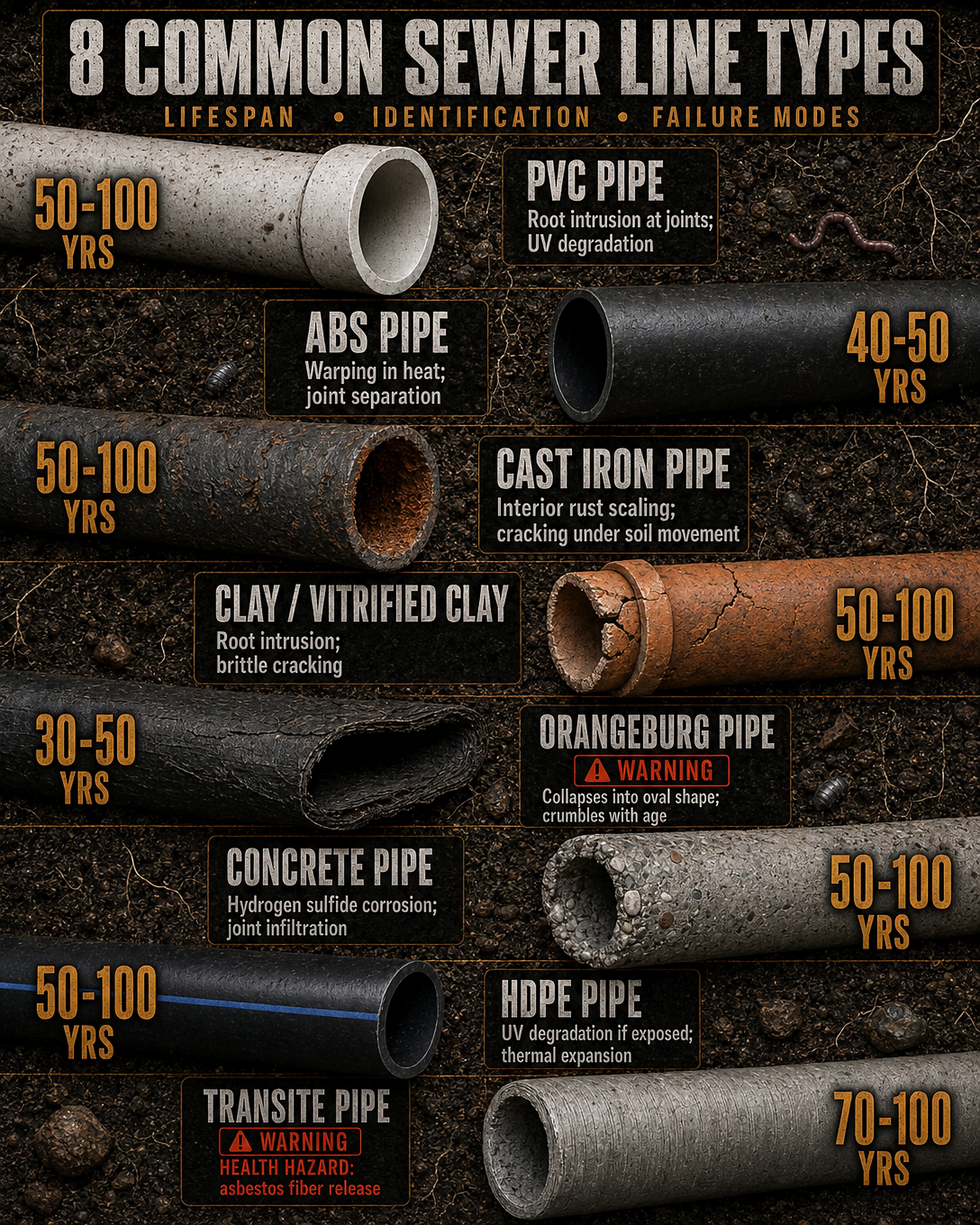
The pipe material helps separate a routine maintenance issue from a problem that needs more investigation. You do not have to identify every pipe at a glance. It is enough to know which materials commonly bring roots, interior buildup, deformation, brittleness, or replacement planning into the discussion.
PVC and ABS are generally a better starting point, but the installation still matters. Poor joints, an incorrect slope, separation, or shortcuts can cause slow drainage or let water and roots into the line.
With cast iron, scaling, corrosion, and slow drainage can show that the inside of the pipe is narrowing. If the opening is reduced enough, cleaning may not solve the underlying problem.
Clay and vitrified clay are vulnerable at their joints. Roots can enter through a small opening, so past backups or cleanings deserve more attention when mature trees are nearby.
Orangeburg is a compressed wood-fiber product. It can deform as it ages, so identifying it is a reason to ask for a closer evaluation rather than assuming the line will perform like modern rigid pipe.
Transite is both a pipe-age question and a repair-planning question. If asbestos is present, damage or replacement may require specific handling by qualified professionals.